 Breaking
French 10-Year Yields Top US Treasuries for the First Time in 13 Years: Europe's “Core” Is Losing Its Safe-Haven Status


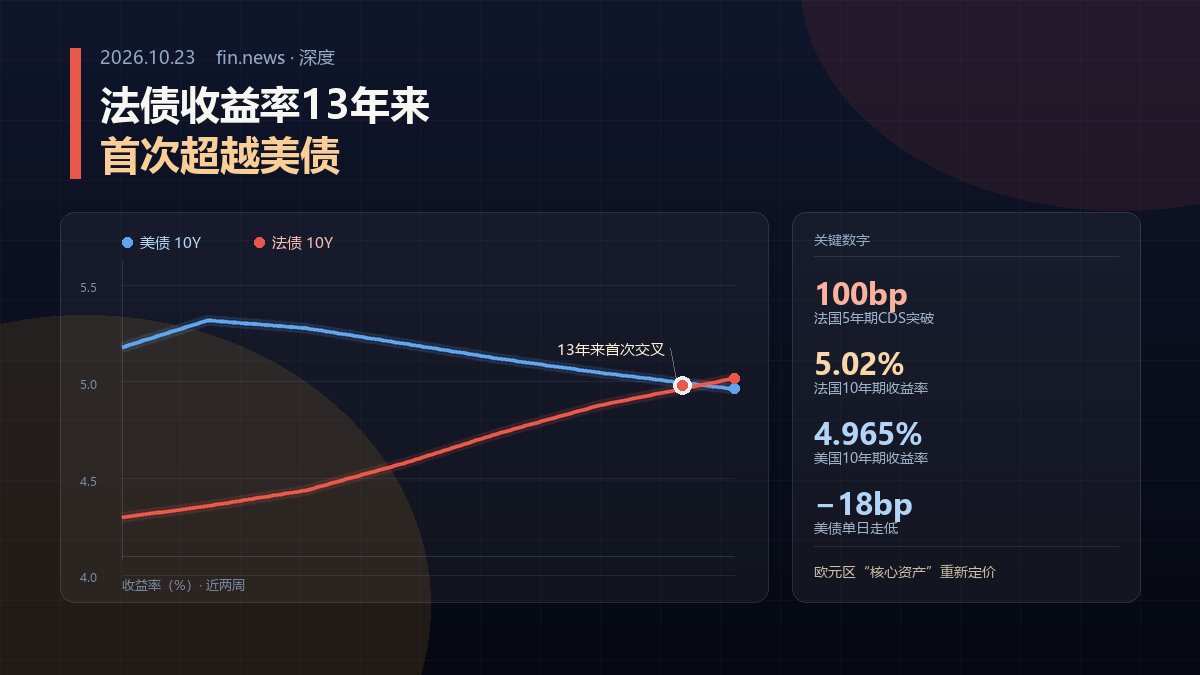
Global bond markets produced a symbolic crossover on October 22: the French 10-year yield rose above 5%, while the US 10-year fell 18 basis points to 4.965% on haven buying - the first time in 13 years that French government debt has yielded more than the equivalent US Treasury. On the same day, the price of five-year French sovereign credit default swaps broke through 100 basis points.
Read together, these two numbers do not describe an ordinary spread fluctuation. They describe a structural shift in how European assets are priced. For more than a decade, French OATs were treated alongside German Bunds as the euro area's "core assets", enjoying funding costs below those of the United States. Now the market is demanding that France pay a premium for its fiscal sustainability.
1. A Historic Crossover: Why French Debt Now Costs More Than US Debt
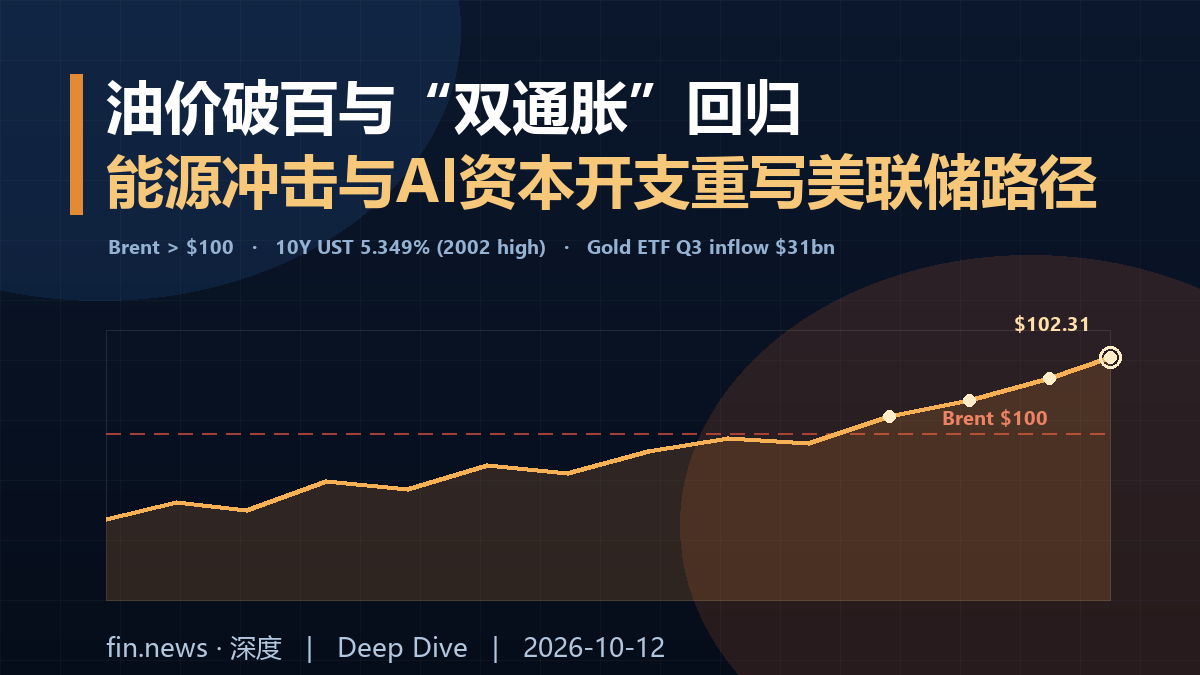
To grasp the weight of this crossover, it helps to see the path that produced it. The US 10-year yield spent much of this year above 5%, touching a 2002 high of 5.349% in early October. The French 10-year sat in a 4.2%-4.6% range over the same period, roughly 60 basis points cheaper than US debt.
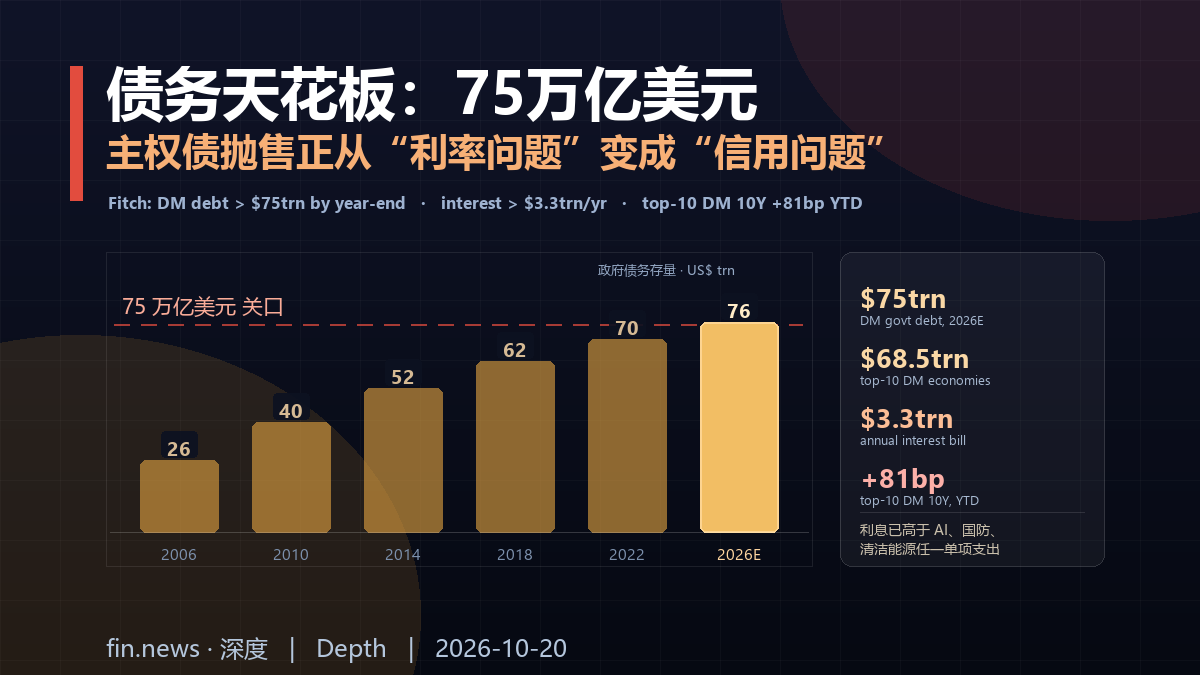
The change came in the past two weeks. On October 20, Fitch warned that advanced-economy government debt would exceed $75 trillion by year-end and named the United States, France and the United Kingdom as exposed to sovereign downgrades. On October 17, demonstrations and clashes broke out in several French cities. On October 19, French bonds were sold again, with yields up 10bp in a session and the France-Germany spread widening by the same amount. By October 22, as US Treasuries drew heavy haven demand from an equity selloff and yields fell 18bp in a day, the two curves completed their historic crossover.
In other words, this is not simply a story of French yields rising. It is a two-way convergence: French debt is falling while US debt is rallying. On one side, fiscal and political risk are pushing French risk premia higher. On the other, a global risk-asset correction is driving capital into the deepest, most liquid haven market. The two forces point in opposite directions, yet they pulled two curves that had been 60bp apart onto the same line - and then flipped them.
2. Why France: Deficit, Gridlock and Ratings, Stacked
France sits at the epicentre of this round of European sovereign stress because three conditions hold at once.
First, the debt and deficit are large. France's public debt-to-GDP ratio has long ranked among the highest in the euro area, and its fiscal deficit has exceeded the EU's 3% ceiling for years. In a rising-rate cycle, the refinancing cost of the existing stock is repriced quickly - precisely the mechanism Fitch emphasised. The level of debt is not the problem in itself; rolling it over at higher rates is.
Second, political consensus is thin. Facing high debt and high deficits, the only available path is higher taxes and lower spending. Both hit household purchasing power and public services directly, which in turn triggers street politics. The clashes of October 17 show that fiscal consolidation lacks social absorptive capacity.
Third, rating pressure has become concrete. Once a major agency publicly flags a country for a possible downgrade, the risk models of insurers, pension funds and banks begin to price in higher capital charges, and selling often precedes the rating action itself. Markets trade expectations, not accomplished facts.
Together these form a loop: fiscal pressure demands austerity, austerity triggers protest, protest erodes political consensus, adjustment becomes harder still, and the risk premium keeps climbing. Once that loop closes, no single policy tool can break it.
3. CDS Through 100bp: From a Rate Problem to a Credit Problem
Five-year CDS breaking 100bp deserves more attention than the yield itself, because CDS price default protection rather than the cost of money.
A rising yield can mean two things: inflation expectations are climbing, or term and credit premia are climbing. If it is the former, it is a monetary-policy problem that a central bank can manage through hikes or guidance. If it is the latter, it is a fiscal-sustainability problem that a central bank cannot fix - and that may even force it into "fiscal dominance" through bond purchases.
The test is whether inflation expectations are rising in parallel. Euro-area inflation expectations are not out of control, yet French yields are rising independently and CDS are widening. That tells us the market is pricing credit and term premia, not inflation. It matches the core conclusion of this week's sovereign-debt research: global bond markets are shifting from a rate problem to a credit problem. France simply drags that conclusion to the front of the stage. Once a core sovereign's credit is repriced, the euro area's rate anchor is no longer the ECB's policy rate but the sovereign risk premium.
4. Will the Sovereign-Bank "Doom Loop" Return?
The transmission mechanism at the heart of the 2011-2012 euro crisis was the sovereign-bank doom loop: banks held large amounts of their own government's debt, falling bond prices eroded bank capital, banks were forced to sell bonds, prices fell further, and a sovereign bailout became necessary from a sovereign that could no longer afford one.
This time the starting point is different, but the interface of the chain still exists. Large European banks remain the main holders of their own sovereign debt. CDS through 100bp raises their wholesale funding costs. A downgrade would lift regulatory capital requirements further. What is different is that Europe now has a banking union, a single supervisory mechanism and the ECB's Transmission Protection Instrument (TPI), which in theory can break the loop.
But the TPI carries a crucial precondition: it is a conditional, political tool. It requires the recipient to comply with fiscal rules and sign an adjustment programme. When the problem is precisely that political consensus cannot sustain fiscal discipline, the instrument's usability is weakened. The fire wall exists - but activating it requires the people it protects to agree first. That is exactly what France lacks most right now.
5. The Mirror Image: Why Treasuries Rallied on the Same Day
To understand French debt, one must also understand the Treasury rally of October 22. The US 10-year fell about 18bp to 4.965%, below 5% for the first time in a month; the 2-year fell about 17bp to 4.65%; the 30-year stood at 5.317%. It was the strongest single-day haven move in more than two years.
The trigger was a violent risk-asset correction. The Nasdaq fell 2.60% to 26,008.86, its worst day since June; the S&P 500 lost 1.21%; the Philadelphia Semiconductor Index plunged 6.72%, with Nvidia down 4.4% and Broadcom down 4.3%. Meta fell 7.0% despite beating on revenue, as investors questioned its $135-145 billion annual capex plan and the creation of non-voting shares to finance AI expansion. Tesla fell 3.1% despite a beat, with net income down 43% to $787 million.
Capital left the longest-duration assets - AI growth stocks - and rushed into the deepest, most liquid market - Treasuries. French government debt is neither "long-duration growth" enough nor deep enough to absorb flows without friction, so it is caught in the middle: it gets no haven bid when risk appetite falls, and it is sold when risk premia rise. That is the real meaning of a fading "core asset" halo.
6. Europe's Policy Trap: Stagflation Meets Fiscal Dominance
France's problem is not isolated; it reflects a policy dilemma across Europe.
On one side, inflation pressure is returning. Brent's December contract rose 4.0% to $113.17 a barrel on October 22, with WTI near $100 as Middle East supply risk pushed energy back to elevated levels. Japan's September CPI rose to 2.1% year on year, with core CPI also at 2.1%, the highest since December 2025. Energy-driven inflation makes aggressive ECB rate cuts difficult.
On the other side, fiscal pressure demands lower rates. Rising refinancing costs directly compress fiscal space and increase banking-system fragility. If the ECB buys government bonds to compress member-state spreads, it slides into "fiscal dominance" - monetary policy serving fiscal financing rather than price stability.
The result is an awkward combination: inflation does not permit easing, and fiscal accounts cannot withstand tightening. That is the textbook position of "stagflation plus fiscal dominance", and it explains why French risk premia are unlikely to fall back naturally in the near term.
7. Three Allocation Implications and Four Windows to Watch
First, redefine "safe assets" from "the country" to "liquidity". We used to treat advanced-economy sovereign debt as a single risk-free block. It now needs to be tiered by market depth, currency status and fiscal sustainability. Treasuries and Bunds still earn a haven premium; the debt of highly indebted core countries is priced more like a credit product.
Second, separate "currency risk" from "credit risk" in euro assets. The euro traded near $1.12 on October 22 while the dollar index slipped 0.18% to 101.599. FX volatility masks the credit tiering inside the bond market - holding euro assets is not the same as holding euro credit, and the two need separate hedges.
Third, gold's "haven" label was disproved again. Spot gold fell 2.78% to $4,025.42 an ounce on the same day, briefly breaking below $4,000 for the first time since July, while spot silver dropped 5.85% to $54.57. Within a real-rate and dollar-liquidity framework, gold responds far more to real rates than to credit events. The real haven remains the most liquid slice of sovereign debt.
Four windows are worth tracking: first, the parliamentary path of France's fiscal plan and the evolution of street politics; second, whether the France-Germany 10-year spread can stabilise inside 100bp; third, the language on the long end in the Fed's October 28 statement; fourth, rating-agency actions ahead of the November refinancing peak.
Conclusion: The first crossover in 13 years is not a technical break but a reset of how the euro area's "core assets" are priced. Once the market demands that a core sovereign pay for fiscal sustainability, Europe's rate anchor shifts from the central bank's policy rate to the sovereign risk premium. For investors, the most important takeaway is this: "advanced-economy government bonds" is no longer a homogeneous asset class, but a set of credits and currencies that must be re-assessed one by one for credit quality and liquidity.