 Breaking


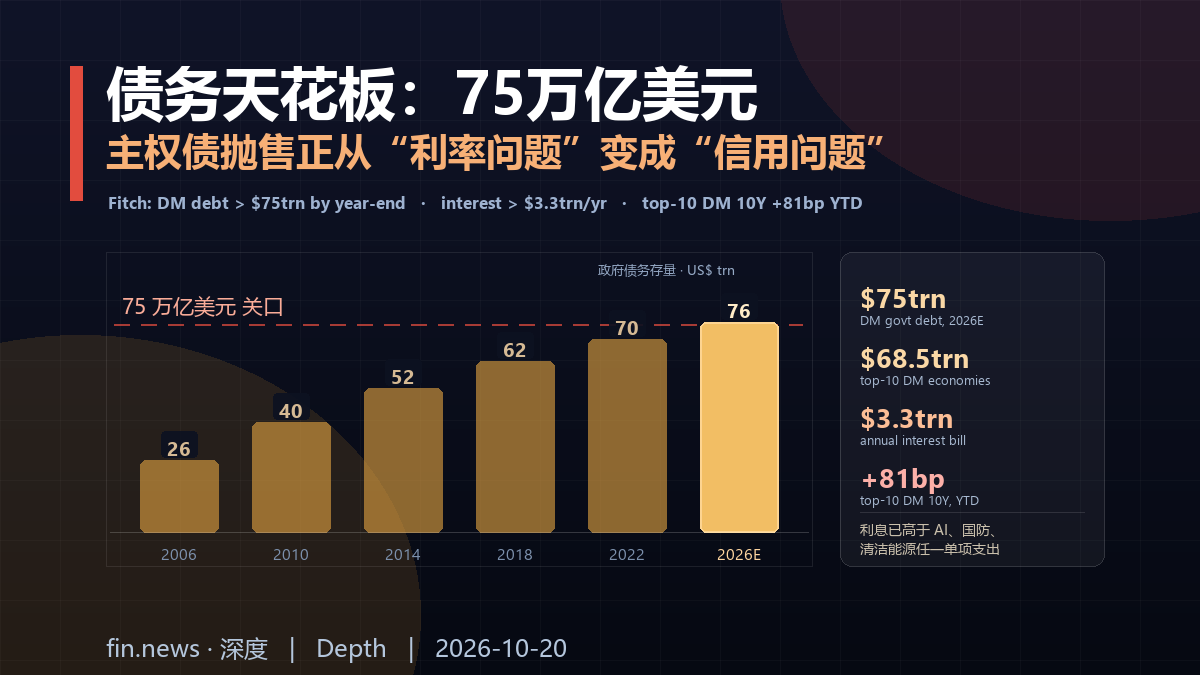
Governments are finding it ever more expensive to borrow. A new report from Fitch Ratings expects developed-market government debt to rise by roughly $4 trillion this year to more than $75 trillion by year-end, with the top ten developed economies alone owing $68.5 trillion. Twenty years ago the figure was just $26 trillion.
The composition is more alarming than the total. Fitch singled out the United States, France and Britain as facing threats to debt stability, warning that the risk of sovereign rating downgrades is rising. This is no longer a simple rate adjustment: markets have begun to reprice the solvency of governments themselves.
1. An 81bp Average Rise - and the Biggest Movers Are the Weakest Credits
Fitch data show that 10-year government bond yields across the world's ten largest developed markets have risen by an average of 81 basis points this year. The countries with the sharpest increases are generally those with the weakest public finances: France, Italy, the United States, Japan and Britain.
That sentence is really about stratification. Markets are not repricing "all sovereign debt" uniformly; they are pricing by fiscal fundamentals. Yield increases are universal, but the dispersion of the premium is selective.
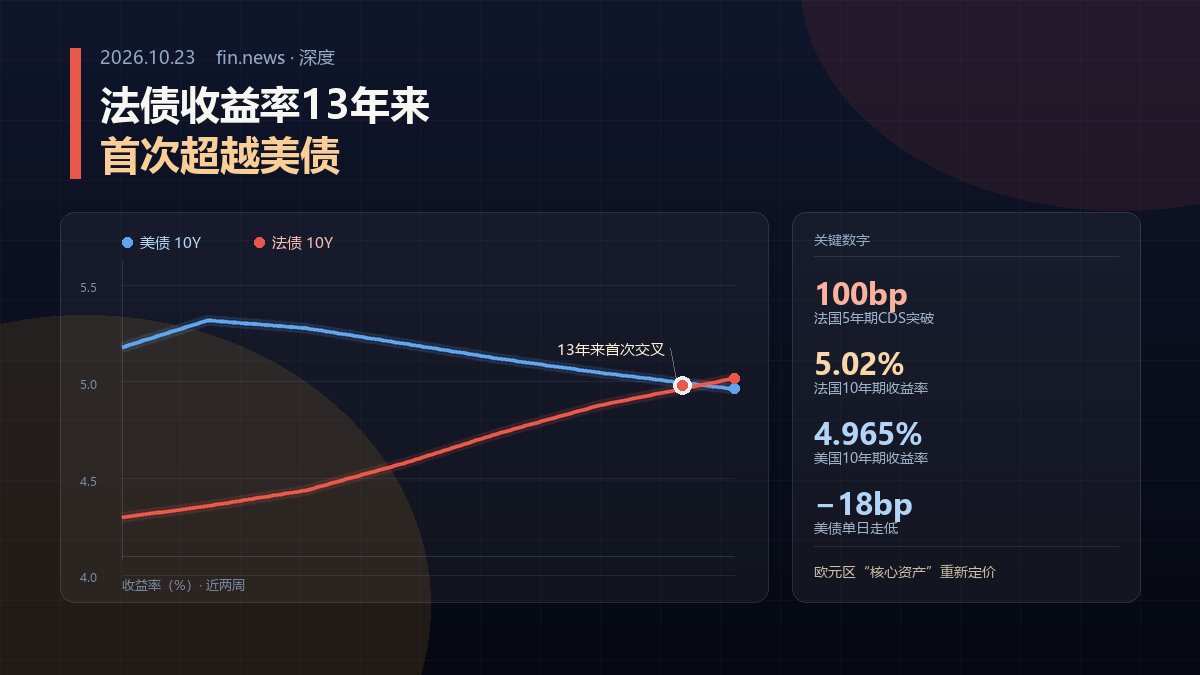
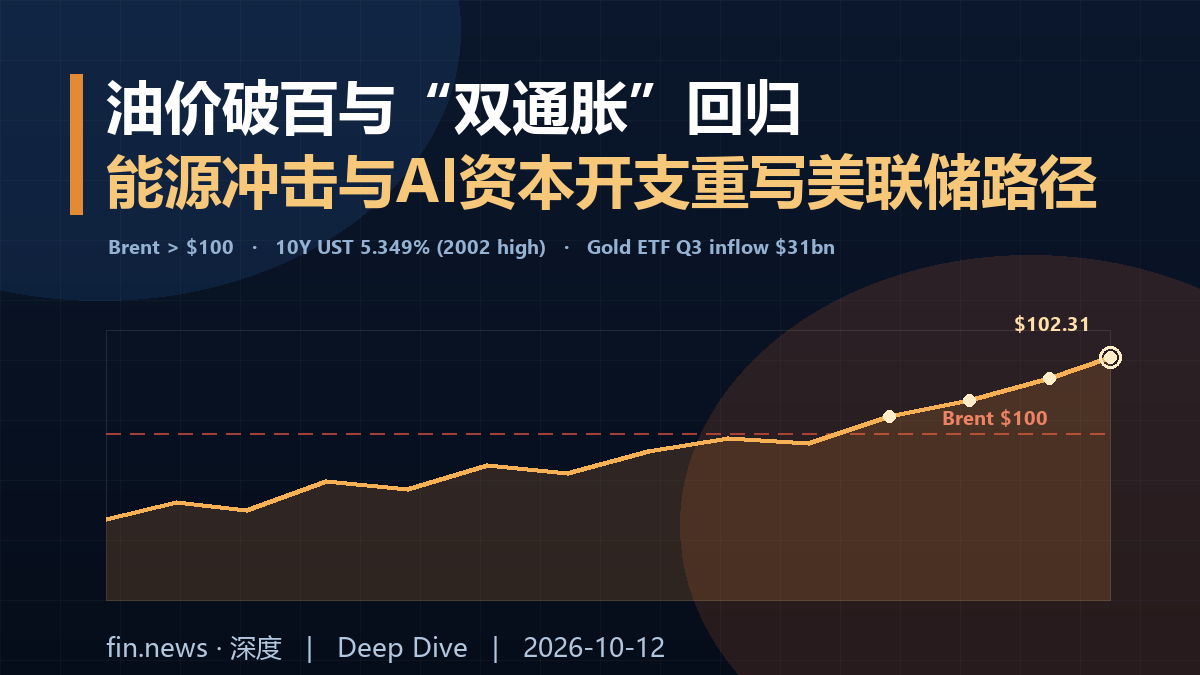
The October readings are stark. The US 10-year yield rose as high as 5.36% (having touched 5.349% intraday on October 5), the highest since 2002. France's 10-year approached 5%, a 24-year high. Britain's 30-year broke through 6%, the highest in 28 years, since 1998. Japan's 10-year crossed 3%, its highest level since 1996. At Monday's (October 19) close the US 10-year was back at 5.141%, the 2-year at 4.785% and the 30-year at 5.476%. The same day, French 10-year yields rose more than another 10bp, the France-Germany 10-year spread widened by 10bp, and the valuation discount on French and German equities widened to the largest since 2009.
2. $3.3 Trillion of Interest - Larger Than AI, Defence or Clean Energy Individually
A September 23 report from the Institute of International Finance (IIF) provides a sharper cross-section: global debt rose by $10 trillion in the first half to more than $365 trillion, while over the past year developed economies paid more than $3.3 trillion in interest on government bonds traded in international markets.
Set that against the major spending categories. The interest bill exceeds global spending on artificial intelligence ($2.6 trillion), on defence ($3.1 trillion) and on clean energy ($2.3 trillion) - each taken on its own. In other words, "interest paid by developed economies" is now a larger line item than any single one of those strategic spending areas.
This is the most overlooked yet most direct driver of asset pricing in the current macro narrative: interest is a rigid expenditure, senior to industrial subsidies, infrastructure, research and redistribution. Once fiscal resources are locked up by debt service, a government's ability to run counter-cyclical policy is structurally weakened.
The IMF's Fiscal Monitor stretches the trajectory further. Global gross government debt reached almost 94% of GDP in 2025 and, on current trends, will hit 100% by 2029 - a level previously reached only in the aftermath of the Second World War. Interest payments have risen from 2% to nearly 3% of global GDP in four years. The United States runs a general government deficit of 7-8% of GDP even near full employment, with gross debt projected at 142% of GDP by 2031. China's overall deficit has widened to nearly 8%, with debt heading toward 127% of GDP.
3. From a Rate Problem to a Credit Problem: Ultra-Long Yields Diverge From Inflation Expectations
Fitch chief economist Brian Coulton offers a key observation: it is not only short- and medium-dated bonds sensitive to monetary policy that are in turmoil - 30-year and other ultra-long yields are climbing in parallel, while medium-term inflation expectations have remained broadly stable. "That suggests broader supply and demand factors are also at work," he said.
This is an important distinction. If the rise in long yields merely reflected inflation expectations, it would be a rate problem, explainable by the policy path and repairable when policy turns. But when inflation expectations are stable and the ultra-long end rises independently, markets are pricing term premia and fiscal sustainability - a credit problem.
Absent demand and squeezed supply are happening at once. The IMF's World Economic Outlook, published October 13, estimates net borrowing by advanced economies will reach 5.2% of GDP this year, the highest since 2021. Governments keep issuing to fund spending and refinance maturing debt while AI giants raise heavily in the bond market - and the global "scramble for capital" has been laid bare this October.
4. The French Case: A Negative Feedback Loop of Pressure, Austerity, Protest and Paralysis
The debt problem is already spilling over into social unrest. On October 17, demonstrations and violent clashes broke out in several French cities, with participants venting anger over high prices and a rising cost of living. Facing high public debt and fiscal deficits, the government's plan is to improve public finances through tax increases and spending restraint - which in turn raised fears of declining purchasing power and damaged public services.
The result is a closed negative loop: fiscal pressure demands austerity, austerity triggers protest, protest erodes political consensus, and fiscal adjustment becomes harder still.
France is the clearest window because it combines three conditions at once: a large debt stock, a large deficit and weak political consensus. When all three stack up, any austerity is amplified by street politics. Monday's further 10bp rise in French yields, the 10bp widening of the France-Germany spread and the widest Franco-German equity valuation discount since 2009 are direct mappings of that loop into asset prices.
5. Two IMF Reports: The Real Risk Is "Disorderly"
During the World Bank and IMF annual meetings in mid-October, the Fund was blunter. Its Global Financial Stability Report warned that a renewed deterioration in inflation or government finances could send sovereign yields sharply higher; elevated public debt and rollover risk remain unresolved, raising the probability of a disorderly rise in yields that could trigger broader financial market turmoil.
The IMF also estimates that global "debt-at-risk" three years out will approach 117% of GDP, with a gap of roughly 20 percentage points between the median projection and the right tail - implying a markedly right-skewed distribution in which extreme outcomes deserve more preparation than central ones.
The word "disorderly" is the point. An orderly rise means price discovery, giving markets time to adjust positions. A disorderly rise means a liquidity break, triggering margin calls, leveraged liquidations and cross-market contagion. The former is a valuation problem; only the latter is a systemic risk.
6. Three Allocation Implications and the Windows to Watch
First, the anchor for long-end rates is shifting from monetary to fiscal policy. The Federal Reserve is expected to hold rates at next week's meeting, but even with policy on hold the long end may keep climbing on supply pressure and term premia. Anyone watching only the policy rate will systematically underestimate duration risk in bonds.
Second, duration is the most expensive exposure of this cycle. With the US 30-year at 5.476% and the UK 30-year having broken 6%, the ultra-long end is far more sensitive to fiscal headlines than the front end. The logic for bond allocation should be to shorten duration and raise coupon, not to extend duration in pursuit of capital gains.
Third, gold's traditional relationship with real rates is loosening. Spot gold fell to around $4,140/oz on Monday as the dollar firmed and Treasury yields stayed high, with COMEX gold futures closing down 0.49% at $4,139. But with Middle East geopolitical risk and sovereign credit uncertainty stacking up, the pullback looks more like position rebalancing than a reversal in the pricing logic.
Notably, transmission to the real economy has already appeared: US homebuilder confidence has fallen to a 14-year low, with sales persistently weak. The squeeze from high rates on rate-sensitive sectors is turning from "expectation" into "data".
Four windows are worth watching: first, next week's Fed statement and its language on the long end; second, the passage of France's fiscal plan and the evolution of street politics; third, the refinancing calendar as major economies' maturing debt rolls from November; fourth, the IMF's Middle East and Central Asia regional outlook on October 22 and its assessment of energy and fiscal spillovers.
Conclusion: $75 trillion is not an endpoint but a milestone. What needs repricing is not the absolute size of the debt, but the speed at which sovereign credit premia are re-rated under the combination of high debt, high rates and weak political consensus. For investors, the most important signal from this rout may be this: the word "risk-free" in the risk-free rate is being redefined.