 Breaking
Oil Above $100 and the Return of “Dual Inflation”: How the Energy Shock and AI Capex Are Rewriting the Fed’s Path


In the first week of October 2026, the pricing logic of global markets was rewritten by two documents at once: the minutes of the Federal Reserve’s September meeting, released on October 7, and a warning issued the same day by the International Monetary Fund at its Annual Meetings preview. The former formally added “geopolitics” and “artificial intelligence investment” to its list of inflation risks; the latter said plainly that even if the Gulf conflict ends soon, high energy prices could persist into 2027.
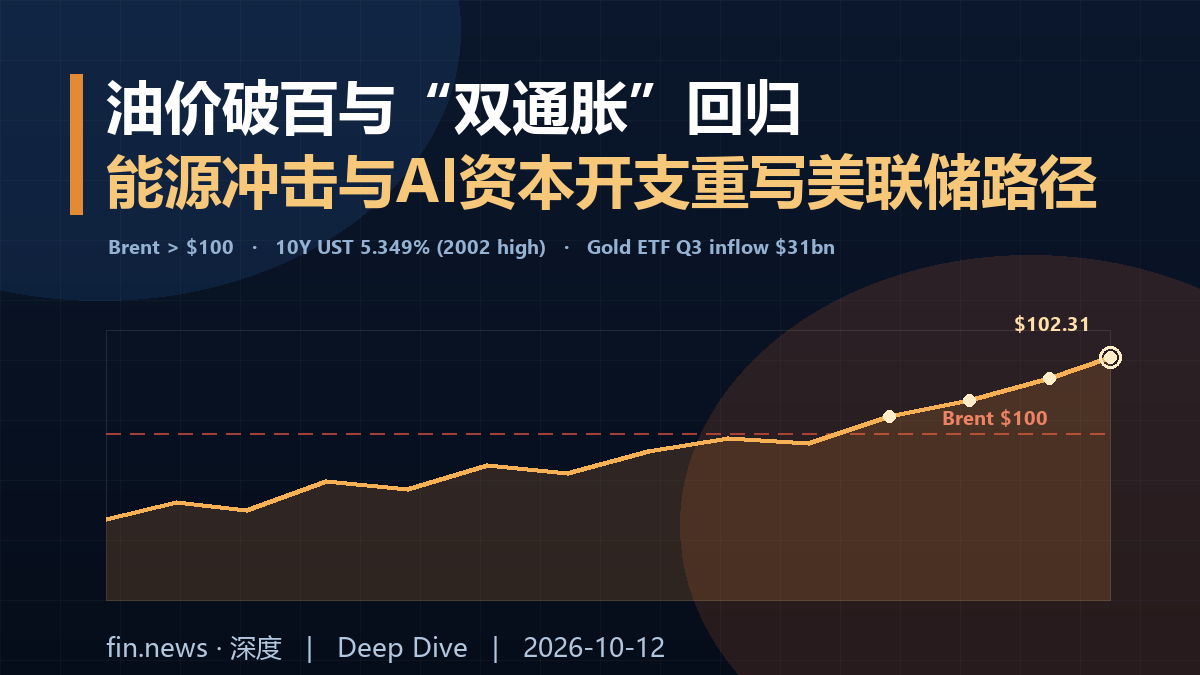
As of October 9, Brent crude was still holding above $100 a barrel, the 10-year Treasury yield had touched 5.349% intraweek — the highest since 2002 — and London spot gold, after sliding towards $4,100 an ounce, had rebounded to $4,197. These three seemingly contradictory quotes together sketch the main thread of fourth-quarter macro trading: the centre of gravity of inflation is shifting from demand towards supply and capital expenditure.
1. Two New Names in the Minutes: Geopolitics and AI
The minutes of the Fed’s September 15–16 meeting, published on October 7, show that all members agreed to raise the target range for the federal funds rate by 25 basis points to 3.75%–4.00%. The more notable detail is the language: most participants judged that a further increase in the target range later this year could be appropriate.
The minutes identify two new sources of inflation. First, “persistent geopolitical tensions had pushed up prices of crude oil and refined products.” Second, “the surge in artificial-intelligence-related investment had added to inflationary pressure.” Their weight lies in what they describe: variables that conventional monetary tools cannot directly influence — one an external supply shock, the other a private-sector capex race.
In other words, the Fed is not facing demand-driven overheating but a compound price pressure built on the supply side and the investment side. That explains why officials remain silent on rate cuts even as employment data soften.
2. Brent Breaks $100: A Supply-Driven Inflation Pulse
Geopolitical risk is the direct trigger for this leg up in oil. On October 1, US media reported that Washington planned to deploy a third aircraft carrier and as many as 10,000 additional troops to the Middle East, sharply raising fears of an escalation between the US and Iran and of disruption to shipping through the Strait of Hormuz. At the close that day, November light sweet crude on the New York Mercantile Exchange rose 2.71% to $92.87 a barrel, while December Brent gained 4.37% to $102.31.
The Strait of Hormuz carries roughly one-fifth of the world’s seaborne crude. Any expectation of disruption is priced in quickly. Unlike the demand-recovery-driven rally of 2022, this move stems almost entirely from supply-side uncertainty — which makes its transmission into monetary policy more direct: energy enters CPI quickly and recedes slowly.
3. The IMF’s Warning: High Oil May Last into 2027
IMF Managing Director Kristalina Georgieva said in Singapore on October 7 that even if the current conflict in the Gulf ends soon, high energy prices could persist for some time, and that on the basis of Brent futures the period of elevated oil prices is expected to extend into 2027. That assessment echoes the Fed minutes: energy is no longer a one-off pulse but a component of the medium-term inflation baseline.
For emerging markets the judgement carries a double constraint. On one side, higher energy import costs erode the current account; on the other, a stronger dollar and higher Treasury yields tighten external financing conditions. That the IMF and World Bank chose this moment, ahead of their Annual Meetings, to signal this risk is itself telling.
4. Yields at 5.349%: Term Premium and a “Higher-for-Longer” Repricing
The bond market cast the most direct vote. Intraday on October 5, the 10-year Treasury yield reached 5.349%, the highest since 2002. Two forces drove it: expectations that policy rates will stay higher for longer, and the term premium demanded by an ever-growing supply of government debt.
The result is a self-reinforcing loop. Energy and AI investment lift inflation expectations; inflation expectations lift long-end yields; long-end yields raise the funding costs of companies and governments; and rising funding costs further intensify the competition for capital between AI capex and sovereign bonds. Broadcom’s $50bn financing arrangement for OpenAI is a microcosm of “compute capital” and “sovereign bonds” competing for the same pool of money.
5. Gold’s Contradictory Signal: Falling Prices, Inflowing Money
As a traditional inflation hedge, gold traced a “drop-then-stabilise” path this round. London spot gold closed at a reference $4,157.41 an ounce on September 30 and fell to $4,110 on October 7, a decline of about 1.14%. On the first domestic session after China’s National Day holiday, Au99.99 on the Shanghai Gold Exchange opened at RMB 890.5 per gram, and the Shanghai Gold morning benchmark was RMB 894.48 per gram, down about 1.42% from the September 30 close of RMB 907.32.
A stronger dollar and rising real yields are the two hands pressing on gold. Yet another data set reveals the other side: according to the World Gold Council, global physically backed gold ETFs took in $10bn in September, driving a record quarterly inflow of $31bn in the third quarter; holdings rose 67 tonnes in September to 4,256 tonnes, a record high. On October 9, London spot gold rebounded 1.53% to $4,197.50 an ounce.
Falling prices alongside inflowing money show that the market is treating gold as an allocation instrument rather than a trading vehicle — and that under the twin pressure of rates and the dollar, central-bank buying and diversification demand continue to provide a floor over the medium term.
6. Three Implications for Asset Allocation
First, the trading logic of inflation is switching. If the 2024–25 narrative was “demand cooling, inflation falling,” the keyword for the fourth quarter of 2026 is “supply shock and capital expenditure.” The former favours duration assets; the latter does the opposite. Investors need to re-examine their duration exposure.
Second, energy and AI are becoming two sides of the same coin. Both are cost-push in nature and both are capital-intensive. The difference is that energy prices are driven by geopolitics and swing violently, while AI capex is driven by corporate cash flow and technology cycles and is more trend-like. In a portfolio, they contribute to inflation in the same direction, so their diversification benefit is limited.
Third, the negative correlation between gold and long bonds may weaken. When rising inflation expectations coincide with fiscal supply pressure, gold and long bonds come under pressure together; the static “60/40” or “bond-gold hedge” allocation needs to be managed dynamically. The World Gold Council’s quarterly data show institutions moving gold from a “safe-haven position” to a “structural allocation position.”
7. What to Watch Next
Three windows will decide the direction of the fourth quarter. First, the US third-quarter earnings season that opens on October 13, where cash-flow validation of AI capex will bear directly on the financing capacity of the technology sector. Second, inflation data in late October, and in particular how far the energy component passes through into core inflation. Third, the Fed’s October meeting — markets now price a probability above 70% for holding rates steady, but inflation and energy risk mean the possibility of one more hike this year has not disappeared.
The conclusion is clear: the market in the fourth quarter of 2026 is no longer a trade around the “timing of rate cuts” but a repricing around the “migration of the centre of gravity of inflation.” Whoever identifies the cost pressures on the supply side and the capex side earlier will take the initiative in that repricing.