 Breaking


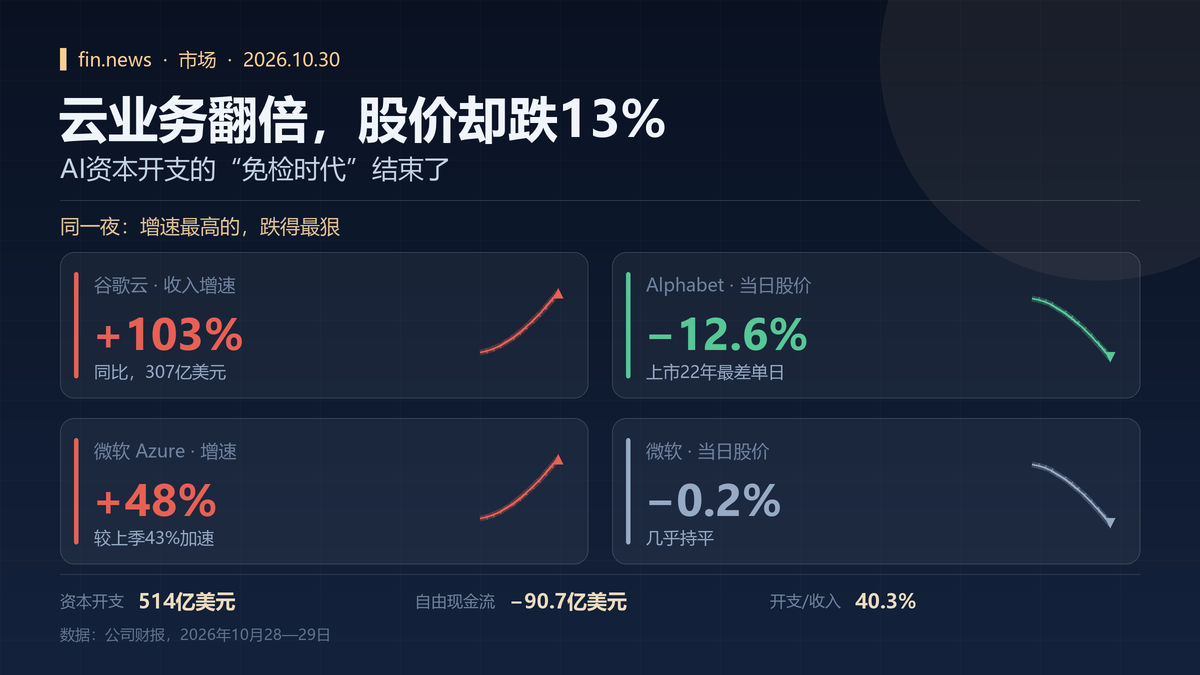
On October 29, 2026, Alphabet delivered a quarter that, by any "AI bull market" narrative, deserved a standing ovation: Google Cloud revenue of $30.71 billion, up 103% year over year, operating profit of $11.1 billion - nearly triple the prior year - and a backlog of $561 billion.
Then the stock fell 12.6% to $283.82, the worst single day in the company's 22 years as a public company, erasing more than $500 billion of market value and dragging the Nasdaq-100 to a combined wipeout of over $693 billion. The same evening, ServiceNow plunged 27.0%, its largest one-day fall since its 2012 IPO, and Fortinet dropped 20.1%.
This is the most instructive paradox of the AI cycle so far: the growth was real, and so was the punishment. To understand it, "how much was spent" and "what the money became" have to sit on the same page.
1. Look at Breadth First: This Was Not a Broad Risk-Off
Before dissecting individual names, one correction to the headline narrative. The Nasdaq Composite fell 1.38% to 26,184.72, the S&P 500 lost 0.30% to 7,720.39 and the Dow fell 0.25% to 52,342.56 - yet most S&P 500 constituents rose. The Russell 2000 and the S&P MidCap 400 both gained, eight of eleven sectors closed green, and healthcare (+2.50%) and real estate (+2.25%) led.
What actually fell was the weighting: communication services dropped 6.60% and technology 0.88%. Capital did not leave the equity market; it was redistributed within it - out of the "AI narrative" and into "cash flow today." Eli Lilly rose 6.6% to a record (quarterly revenue of $24.4 billion, +39%, with full-year guidance raised to $91-92 billion) and ADT jumped 33.2% on a take-private deal. Same direction.
In other words, this is not a March-2000 style top where everyone suddenly doubts the story. It is a targeted repricing of the return on AI capital expenditure.
2. Inside Alphabet's Ledger: 40 Cents of Every Revenue Dollar Went Into Capex
Total revenue was $127.58 billion, up 25% but below the $128.22 billion consensus. Earnings per share came in at $2.12, well short of the $2.99-3.02 expected. The gap was not on the top line; it was in costs and spending:
- Capital expenditure of $51.36 billion, equal to 40.3% of quarterly revenue - forty cents of every dollar earned went back into data centres, chips and power.
- Free cash flow of negative $9.07 billion, versus expectations of negative $3.5 billion, and negative for a second consecutive quarter.
- A $5.2 billion EU fine and an unrealised loss of roughly $8.2 billion on its SpaceX stake.
- Rising TPU inventory absorbed working capital (the company says it is all matched to signed contracts, normal pre-delivery deployment).
Management maintained 2026 capex guidance of $195-205 billion and said explicitly that 2027 capex will rise "significantly" further. With $265.1 billion of cash and securities there is no near-term funding pressure - but the question investors must answer has changed: when, and at what margin, does this money come back to shareholders?
For two years the market's default answer was "spend first, revenue will follow." After October 29, that default no longer holds.
3. The Real Crack Is in Search Ads: AI Is Eating Its Own High Margin
Look only at cloud and Alphabet's quarter is nearly flawless. But what has always underpinned this valuation is not cloud - it is search advertising, a business with almost no marginal cost and extremely high gross margin.
This quarter, AI pushed search query volume to a five-year high, yet search advertising revenue grew only 12% year over year. Management's explanation: AI Mode queries are on average three times longer than traditional search, visual searches exceed 50 billion a month, and monetisation efficiency at this stage is low. The Gemini app has reached 1 billion users, and its API processes nearly 32 billion tokens a minute, four times the prior year.
The data point to a structural contradiction: usage is exploding, but revenue is not keeping pace. AI-generated answers reduce ad slots and clicks, so revenue per query falls - while those answers require several times the compute of classic search, and compute is capex.
So the revenue mix has changed in kind: high-margin search advertising is slowing, low-margin cloud is expanding fast (cloud operating margin of 36.2%, much improved but still below search). Total revenue is still growing, but the quality of that growth is deteriorating, while the spending that supports it is soaring. That is what the 12.6% decline was actually pricing.
4. ServiceNow's 18.5%: The Software Layer Is Decelerating Too
The same day, enterprise software leader ServiceNow fell 27.0% to $109.67. Its quarterly revenue of $4.106 billion, up 20.5%, actually edged past expectations. Two numbers broke the stock:
- Adjusted EPS of $1.00, below the $1.02 expected;
- Guidance for fourth-quarter current remaining performance obligations (cRPO) growth of 18.5%, a clear deceleration from 20.5% in Q3.
The company also raised its 2026 AI annual contract value target to $1.7 billion - good news, but the market was watching the second derivative: backlog growth is slowing, which means revenue recognition over the next twelve months will slow with it. At a 96x price-to-earnings multiple, a slide from 20.5% to 18.5% is not "a small fluctuation" - it is a recalculation of the valuation denominator.
Fortinet is the same logic in another wrapper: it beat, and it raised guidance, but trimmed its full-year services revenue forecast by about $40 million at the midpoint and saw product revenue growth slow. The stock still fell 20.1%, at least 15 brokerages cut price targets and Bank of America downgraded it to neutral. "Beat" is no longer enough; the market wants "beat and accelerating."
5. Why Microsoft Was Spared: The Market Prices the Slope of Returns
Put the three companies side by side and the rule becomes obvious.
Microsoft reported revenue of $92.28 billion, up 19% and ahead of expectations. Azure revenue was $33.2 billion, up 48% - not only accelerating from 43% the prior quarter but ahead of the 44.8% consensus. The stock fell just 0.2%, essentially flat. More tellingly, Microsoft sold at least $25 billion of bonds and drew about $115 billion of orders - its first US investment-grade deal since 2017.
In other words: the capital market's door for AI financing remains wide open, but only for companies whose returns are accelerating.
Alphabet's cloud growth (103%) was far higher than Azure's (48%), so why the heavier penalty? Because investors were looking at the slope of return at the consolidated level: Microsoft's core engine (Azure) is accelerating while Alphabet's core engine (search ads) is decelerating. Microsoft's capex is converting into visible cloud revenue and profit; Alphabet's capex simultaneously crushed free cash flow and has not yet halted the decline in monetisation efficiency of its core business.
That is the change in the pricing rule: from "how much did you spend" to "is your return curve still bending upward." AI capex is no longer exempt from inspection.
6. The Mirror in Chinese Assets: Compute Hardware Sold, Dividends Bought
The same logic played out across Asia-Pacific on October 30. The Shanghai Composite fell 0.82% to 3,651.43, the Shenzhen Component lost 2.92% and the ChiNext Index dropped 4.45% to 2,517.59. Combined turnover was RMB 1.56 trillion, down RMB 72 billion, with more than 4,700 stocks declining.
Losses concentrated in compute hardware: Tianfu Communication fell 19.77%, Eoptolink 11.06% and Zhongji Innolight 8.53%, with optical modules, PCBs and memory hit across the board. Banks, coal and oil - the dividend complex - were strong all session. In Hong Kong the Hang Seng Tech Index fell 2.84% and the Hang Seng Index 0.59%; Tencent lost 2.58% while PetroChina gained 2.91% and ICBC 2.3%.
The sector split is structurally identical to the US: what was sold is the layer that supplies the AI story but has not yet delivered cash flow; what was bought is the asset that pays today. The only difference is that A-share compute valuations depend more heavily on the slope of overseas capex, making them more sensitive to Alphabet's guidance.
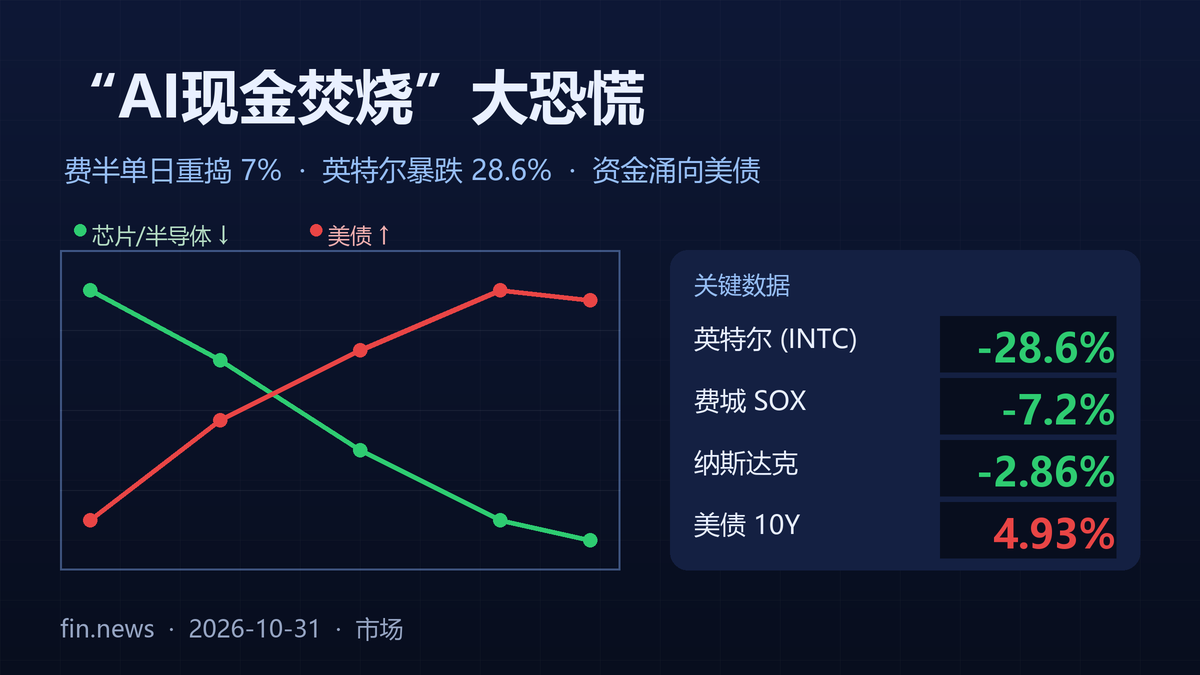
After-hours pressure was not over: Amazon fell 5.7%, Intel collapsed 21.6%, SanDisk lost 3.4% and Nasdaq-100 futures fell another 1.7%.
7. The Macro Mirror: Falling Yields Are Not an Easing Signal
Treasury yields fell across the curve: the 10-year dropped 4.76bp to 4.94%, the 2-year 6.43bp to 4.6373% and the 30-year 3.23bp to 5.3114%, widening the 2s10s spread to 32.65bp. The dollar index closed near 101.9, down about 0.2%, and offshore renminbi strengthened through 6.66 to 6.6569 - the first time since April 2024.
But yields fell because growth and AI earnings expectations weakened at the same time, not because policy turned dovish. On the same day the ECB held rates but officials expect a December hike followed by a pause, with the euro down 0.4% to 1.1111, a 17-month low. The Bank of Japan held at 1.25% and judged underlying inflation to have reached its 2% target, leaving room for a December hike. The Bank of Canada raised 25bp to 2.5%, its first hike since July 2023.
Gold fell 1.17% to $4,021.21 an ounce, touching $4,005 intraday, and silver dropped 3.4% to $52.14 - gold falling while yields fall points to position liquidation, not haven demand. In oil, WTI settled at $101.97, up 0.72%, with Brent around $111; Brent turned higher after the close once Yemen's Houthis announced an attack on Saudi oil facilities. European benchmark gas broke above EUR 100/MWh for the first time in nearly four years.
Assemble the pieces: global policy is still tightening at the margin, and the bond rally is a growth scare, not an easing trade. For high-multiple growth stocks, that means no rescue from the discount rate.
8. Three Variables Next Week and Three Allocation Threads
Variable one: the US midterm elections on November 3. Expectations for the fiscal path, tariffs and sector regulation will all be repriced, and that feeds directly into the term premium at the long end.
Variable two: decisions from the RBA and the Bank of England. With Canada already hiking and the ECB signalling December, any hawkish surprise reinforces the "no global easing" pricing.
Variable three: US payrolls and wage data. If wages stay firm, the fantasy of recession-driven rate cuts gets squeezed further.
On allocation, three threads are relatively clear:
First, move from "narrative premium" to "cash-flow discount." When free cash flow is negative, the multiple the market is willing to pay shifts down systematically. At equal growth, prefer companies whose capex has already been validated by margins over those still "in the investment phase."
Second, separate the shovel-sellers from the gold-diggers. Demand for compute hardware, power, cooling and networking is backed by signed contracts (Alphabet's $561 billion backlog and its contracted TPU inventory are evidence), giving it higher certainty than the application layer - but its valuation beta is also larger, so track the capex guidance of the major cloud providers rather than their share prices.
Third, keep a sleeve of "cash flow today" assets. The simultaneous strength of US healthcare and real estate and of A-share banks, coal and oil is not coincidence - it is the same money making the same choice in two markets.
Conclusion: Alphabet's 103% was not a failure; it proved that AI demand is real. What changed is only the price the market is willing to pay for that growth - when free cash flow is negative and core monetisation is deteriorating, even spectacular cloud growth no longer converts automatically into valuation. The free pass for AI capex is over. Every dollar from here has to answer one question: does it make the return curve steeper, or flatter?