 Breaking


On October 9, the closing day of the first full trading week after China’s National Day holiday, the three main A-share indices traced a textbook dip-then-rebound session. At the close, the Shanghai Composite was up 0.05% at 3,813.79, the Shenzhen Component up 0.17% at 12,641.86 and the ChiNext up 0.22% at 3,043.33. Combined turnover across the Shanghai, Shenzhen and Beijing exchanges reached RMB 1.92trn, RMB 222.4bn more than the previous session. Across the market 3,297 stocks rose and 2,145 fell, with 72 limit-up and 10 limit-down. Sentiment improved at the margin in the first week after the holiday.
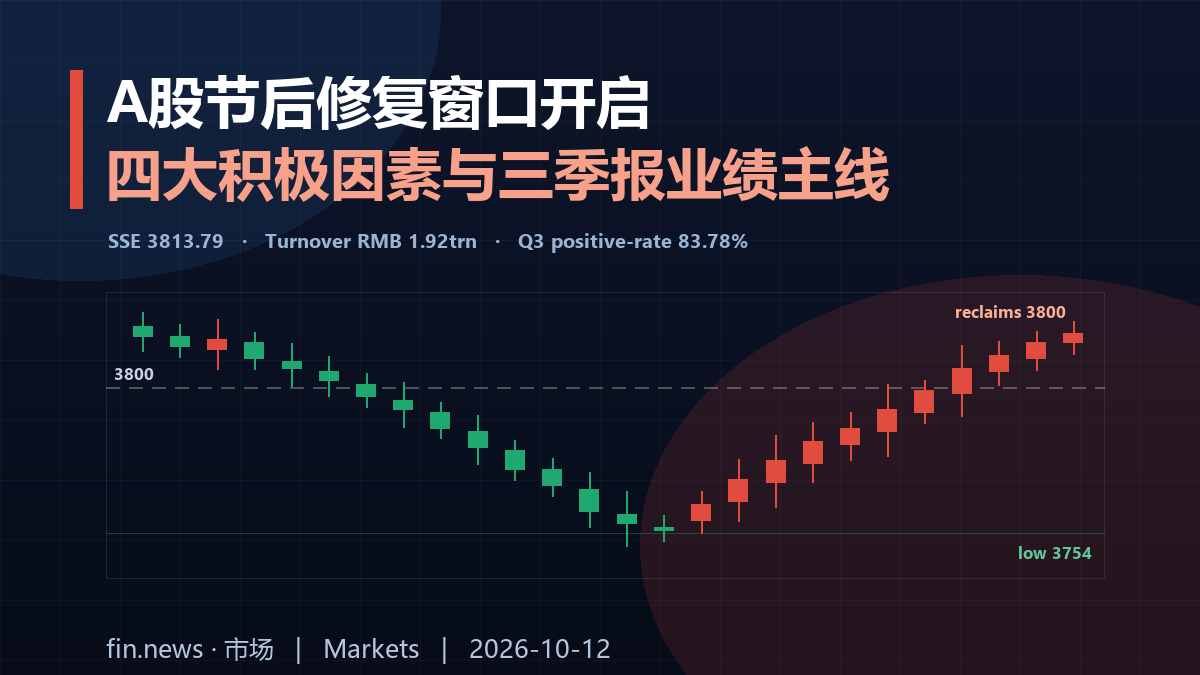
This repair is not an isolated technical bounce. It rests on simultaneous improvement in fundamentals, consumption, dividends and fund flows — and the imminent wave of third-quarter reports may shift the market from a valuation-driven to an earnings-driven phase.
1. The First Week Back: A Classic Dip-and-Rebound
The structure of trading was clear. Among the top-level SW industry indices, media, computer, retail and non-ferrous metals all rose more than 2%; the media sector gained 5.28% overall, with Chinese Online and Mango Excellent Media hitting the 20% limit-up and a cluster of peers following suit. “Content consumption plus AI applications” became the favoured theme. At the other end, defence, electronics and banks lagged — a rebalancing of previously crowded positions.
The sequencing is worth noting. On the first day after the holiday the Shanghai Composite dipped to 3,754 intraday before reclaiming the 3,800 level; the following day produced a V-shaped reversal on heavier volume. In technical terms, “heavy-volume pullback plus next-day reversal” typically signals that near-term selling pressure has been largely digested, and stable margin-financing balances confirm that leveraged funds did not flee in panic.
2. Four Tailwinds, from Fundamentals to Flows
First, fundamentals are steady and improving. Data released on September 30 by the National Bureau of Statistics’ service survey centre and the China Federation of Logistics and Purchasing showed the September manufacturing PMI at 50.1%, up 0.3 percentage points from the previous month and back above the 50 threshold that separates expansion from contraction. Of the 21 industries surveyed, 12 reported PMIs above the threshold, four more than the prior month. Several institutions note the September expansion was driven mainly by production; as growth-support policies take effect, the manufacturing PMI should hold in expansion in the fourth quarter, while demand-side improvement still needs monitoring.
Second, consumption data lifted confidence. Estimates from the Ministry of Culture and Tourism’s data centre show 826 million domestic trips during the seven-day holiday and total domestic tourism spending of RMB 738.375bn, up 6.3% and 4.3% respectively on a comparable daily basis versus 2025. Box-office data from Beacon Professional show the 2026 National Day holiday slate (October 1–7) closed with RMB 1.164bn. The recovery in services consumption and offline activity provides fundamental validation for retail, media and tourism-related sectors.
Third, the dividend ecosystem keeps improving. Data from the China Association for Public Companies show total A-share dividends for the 2025 fiscal year reached RMB 2.4trn, up 3.3% year on year; 3,067 listed companies paid dividends for three consecutive years, a share up 3 percentage points, and a further 2,235 companies paid for five consecutive years, also up 3 percentage points. Stronger sustained payouts are raising the market’s long-term valuation anchor.
Fourth, money has not left the market. Wind data show equity ETFs took in a net RMB 17.907bn on October 8, with broad-based ETFs leading at RMB 10.997bn. Heavier subscriptions to broad-based products typically reflect allocation rather than trading money, providing relatively stable support for the indices.
3. Q3 Season Opens: 83.78% Positive, Earnings as the Divide
As of October 11, 37 A-share companies had issued third-quarter earnings guidance, of which 31 were positive — an 83.78% positive-rate. Semiconductor, auto-parts and biopharmaceutical names stood out. Shandong Wohua Pharmaceutical released the first full third-quarter report on the evening of October 9, formally opening the reporting season.
Institutions broadly expect the earnings factor to replace valuation expansion as the near-term pricing main line from this week: sectors with earnings validation should repair faster, while pure-theme names without earnings support may remain under pressure. Galaxy Securities notes that AI compute and technology hardware offer relatively verifiable Q3 results, highlighting optical modules, memory, electronic fabric, MLCC powders and data-centre power equipment; high-prosperity growth stocks that were previously sold down may see money return.
4. Policy’s Two Legs: New Productive Forces and Long-Term Money
Policy signals have also been dense. The Central Committee of the Communist Party of China and the State Council issued the Opinions on Developing New Quality Productive Forces, proposing full implementation of the “AI+” initiative, strengthening the efficient supply of computing power, algorithms and data, and accelerating AI adoption across industries — further clarifying the top-level policy positioning of the AI industry. At the same time, the securities regulator emphasised long-term capital entry and investor returns in discussions, directly benefiting dividend and high-yield segments.
On liquidity, the central bank’s RMB 1.2trn outright reverse repo was implemented after the holiday, putting cross-quarter and cross-holiday funding arrangements in place, while structural monetary tools were stepped up, including a cut in the PSL rate and an expansion of relending. The finance ministry and the development and reform commission also signalled incremental policy and accelerated construction of the “six networks”, with power grids, storage facilities and construction machinery likely to generate tangible activity first.
5. External Constraints Remain: High Overseas Rates and the Fed’s Path
It is worth being clear-eyed: external constraints have not been removed. The 10-year Treasury yield touched 5.349% intraday on October 5, the highest since 2002, and was still around 5.24% as of October 9. The dollar index rose for a fourth consecutive week, its longest weekly winning streak since May 2025. With Fed Chair Warsh maintaining a hawkish tone, the valuation constraint that high overseas rates place on expensive growth sectors will not disappear quickly.
Yet marginal change is emerging. After US September payrolls weakened sharply, market expectations for a Fed hike in October have cooled markedly — CME FedWatch implies roughly a 19.4% probability of at least a 25bp hike in October, against 85.8% for December. If US September CPI this week (consensus 3.7% year on year) comes in benign, external rate pressure should ease further — an important external condition for a rebound in A-share risk appetite.
6. Three Allocation Threads: Offence and Defence
Thread one: technology growth as the offensive leg. Hard-tech segments — semiconductors, AI and advanced manufacturing with core technical barriers — benefit from the upcycle in the global technology industry. Within technology, prioritise AI hardware whose current momentum is easiest to verify in Q3 results, while watching AI middleware, agent orchestration and application platforms with native SaaS capability.
Thread two: resources and dividends as the base. With US real yields at historic highs and overseas disturbances persisting, dividend assets such as banks look more attractive, while copper, gold, aluminium and potash offer both price-appreciation logic and allocation value as a steady base in a choppy market.
Thread three: manufacturing exporters for independence. Leaders in power-grid equipment, forged components for turbines, railway equipment and televisions are posting rapid growth in overseas revenue. Their momentum stems from global demand rather than domestic stimulus, allowing them to deliver excess returns amid volatility.
7. The Week Ahead: A Dense Window of Data and Events
October 12 to 16 is a dense period of data and events. The macro focus falls on Wednesday: China’s September CPI and PPI and its first-three-quarter trade data are due the same day, with the market expecting CPI to pick up to around 1.0% year on year; US September CPI lands the same day. On Friday, Fed Chair Warsh speaks at the IMF Annual Meetings, an important window to read the policy path before the communications blackout. Domestically, the Q3 reporting season opens, and earnings will be the divide between strong and weak.
The conclusion: a post-holiday repair window is opening for A-shares, but it is more likely to be a moderate, twin-engine recovery driven by earnings and policy than a broad trend rally. Until the two threads — overseas rates and Q3 results — are resolved, the index is likely to consolidate and build a base, with structural opportunities outweighing directional ones. The dense flow of third-quarter guidance will dominate sector rotation over the coming weeks.