 Breaking


An Auction That Wouldn't Sell
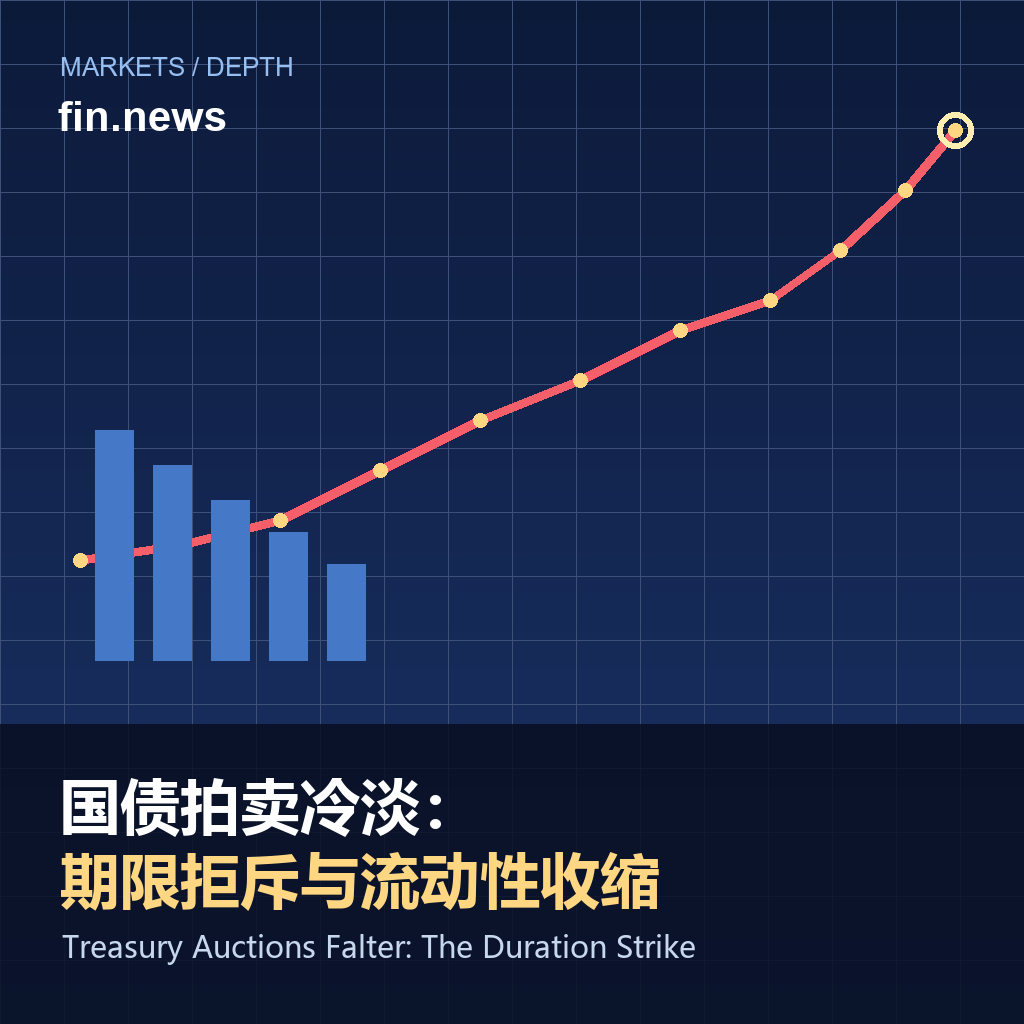
The U.S. Treasury's sale of $70 billion in 5-year notes drew a telling result: the awarded yield came in 3.1 basis points above the pre-auction market level — a “tail,” the clearest sign of weak demand. More striking, primary dealers were forced to take down 15.8% (about $11 billion) of the issue, far above normal. Supply that investors were meant to absorb ended up on dealers' balance sheets.
A Chain Reaction Across the Curve
The tepid auction rippled through the bond market. The 10-year Treasury yield briefly hit 5.23%, the highest since 2007; the 30-year topped 5.40%, its highest close since 2004. Crucially, the 10-year TIPS real yield climbed to a multi-decade high of 2.85%, while the S&P 500's cyclically adjusted (CAPE) earnings yield sits at just 2.44% — inverted for the first time since 2003. The risk-free asset now offers a higher real return than equities' earnings yield, mathematically forcing systematic de-risking.
A Flood of Supply and an Absent Buyer
At root is a mismatch between sovereign supply and private-sector capacity. The Treasury's General Account (TGA) swelled to $924.63 billion at quarter-end, near its $950 billion target, while the Fed remains paused on Reserve Management Purchases, injecting no reserves via Treasury buying. Without that artificial buyer, primary dealers must digest the deluge alone, tightening financial conditions at the margin.
Global Liquidity Is Retreating
This is not only an American story. The ECB raised its deposit rate 25bp to 2.50% in mid-September; the BOJ lifted its policy rate to 1.25%, the highest since 1995, accelerating the unwind of the yen carry trade — long the engine of offshore dollar liquidity and risk-asset leverage. The PBOC is the lone theoretically accommodative major central bank, but its 6-month forward credit impulse remains weak. By CrossBorder Capital's count, the global liquidity cycle has peaked near $189 trillion, its second derivative firmly pointing down.
The Gravity on Asset Prices
When the risk-free rate rises structurally, high-valuation assets feel it first. In the last week of September, banking heavyweights such as Goldman Sachs and Bank of America fell about 8% — their worst week since March — while the Russell 2000 lost 1.8% in a single session. Capital is rotating from duration-sensitive and highly levered names into energy, materials, defensive staples and healthcare.
What to Watch Next
The near-term focus is the 7-year auction: a tail beyond 1bp, or indirect bidding below 60%, would confirm a structural buyers' strike. Quarter-end window-dressing may also spike SOFR. Longer term, roughly $40 trillion of global debt refinancing over the coming year will collide head-on with private absorption capacity amid slowing liquidity.
Takeaway: This selloff stems not from Fed tinkering but from sovereign supply overwhelming private balance sheets. Under a fiscal-dominant, ample-reserves framework, “duration rejection” may become the norm — making valuation discipline and duration management matter more than waiting for a policy pivot.