 Breaking
"Super Central Bank Week" Ends: Energy Shock Forces Global Synchronized Tightening, Reshaping Asset Allocation


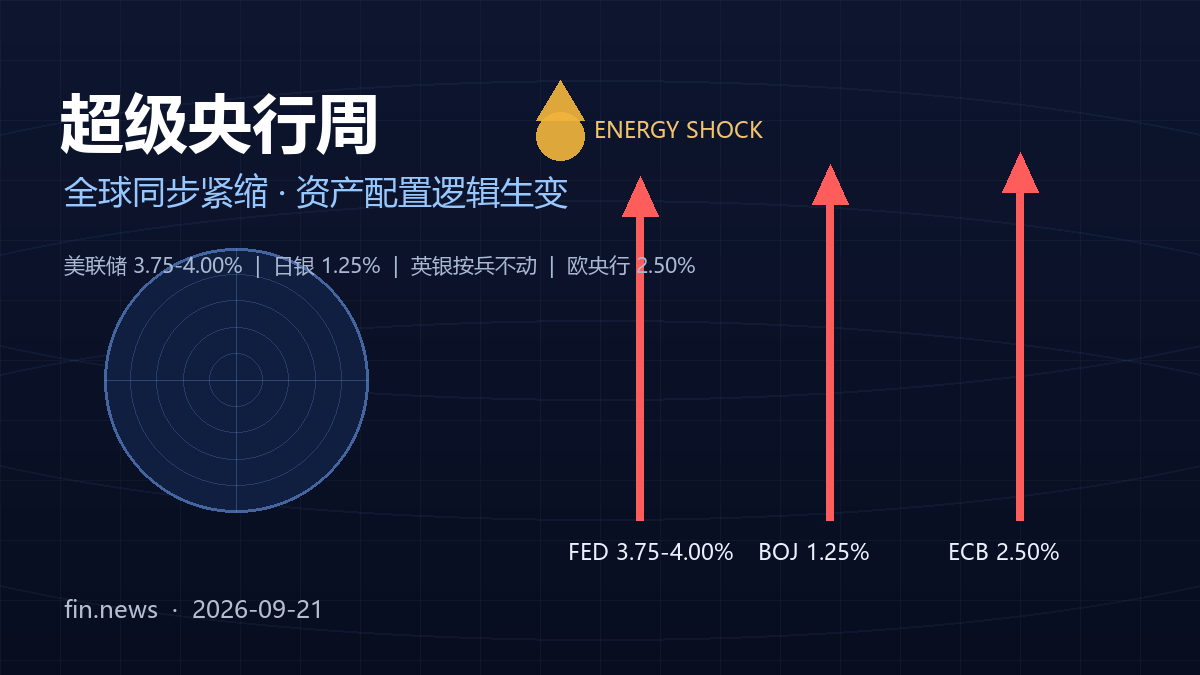
In mid-September 2026, the central banks of the world's three largest economies announced rate decisions within days of one another, an event markets dubbed "Super Central Bank Week." Confronted with energy prices driven up by the Middle East conflict and stubborn inflation, the Federal Reserve and the Bank of Japan raised rates, while the Bank of England and the European Central Bank diverged between holding and moving first. A wave of energy-shock-driven global synchronized tightening is reshaping how major asset classes are priced.
1. The Fed: First Rate Hike in Three Years, Passed Unanimously
In the early hours of September 17 (Beijing time), the FOMC raised the federal funds target range by 25 basis points to 3.75%–4.00% — its first hike since July 2023 and the first policy shift after five consecutive holds. All 12 voting members backed the move, signaling broad consensus on the persistence of inflation. Chair Kevin Warsh stated bluntly: "The plain fact is that inflation is too high and has been for too long." He stressed correcting the market's "data-point dependency," noting future policy will lean more on medium- to long-term inflation trends than on monthly noise.
2. The Bank of Japan: Hike to a 31-Year High
On September 18, the BOJ raised its policy rate from about 1.0% to about 1.25% by a 7–2 vote, with the new rate taking effect on September 24. That is the highest level since 1995 and the shortest interval between hikes since 1990. The BOJ noted that rising corporate costs keep passing through to consumer prices, the wage-to-price pass-through is strengthening, and underlying inflation risks exceeding its 2% target.
3. Britain and Europe: Holds and a Preemptive Hike
On September 17, the Bank of England held its benchmark at 3.75% in a 6–3 vote — its sixth straight hold. Governor Bailey warned that an escalation of the Middle East conflict could force a hike, and the bank abandoned its plan to sell long-term gilts. Earlier, on September 10, the ECB had already raised rates by 25 bp to 2.5%, with several policymakers flagging possible further moves this year.
4. The Common Driver: Energy Shock and Second-Round Inflation
The core variable behind this collective tightening is the energy-price spike triggered by the Middle East conflict. Brent crude briefly approached $110 a barrel before easing to around $105. Central banks broadly fear energy costs will propagate along the "oil price–wages–prices" chain and generate second-round inflation. The Fed's economic projections put 2026 PCE inflation at 3.7%, with a return to the 2% target delayed until 2029.
5. Market Reaction and Asset Allocation
After the decisions, markets diverged. The U.S. 10-year Treasury yield eased to 4.93% while the 30-year fixed mortgage rate rose to 6.95%; the dollar strengthened and the yen and euro came under pressure. For investors, "higher for longer" means: bond coupons regain attractiveness, gold is supported by safe-haven and inflation-hedge logic, and equity valuations face rising discount-rate headwinds. Portfolios should balance defensiveness with cash-flow certainty, and watch the volatility risk of highly leveraged, long-duration assets.
6. Conclusion
"Super Central Bank Week" marks the definitive end of the post-pandemic easing cycle. As global monetary normalization accelerates and geopolitical premiums stay elevated, investors must take a longer view of inflation trends and policy paths. Only by internalizing the central banks' "higher for longer" signal can one capture conviction opportunities in this new high-rate regime.