 Breaking


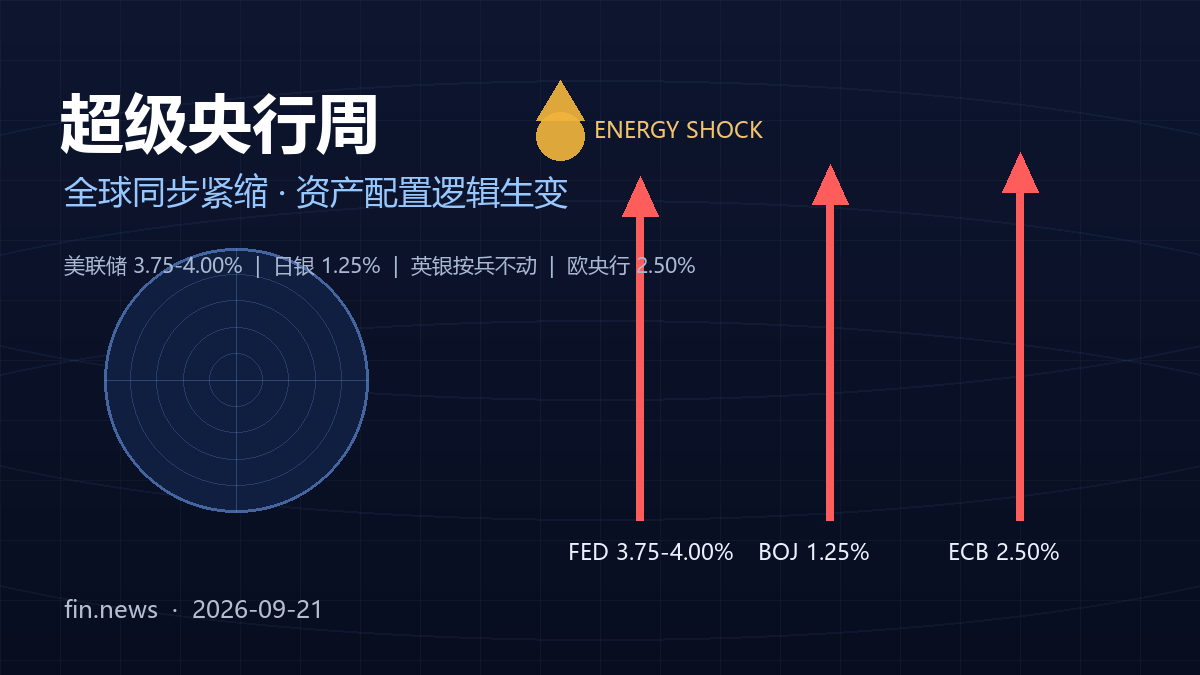
In the early hours of September 17, 2026 (Beijing time), the Federal Reserve announced its September rate decision, raising the target range by 25 basis points to 3.75%-4.00% — its first hike since July 2023. The decision passed with near-unanimous support. Chair Kevin Warsh stressed at the subsequent press conference that inflation "remains too high" and the U.S. economy "appears to be strengthening," hinting that monetary policy still has room to tighten further. Markets interpreted this as the start of a new tightening cycle rather than a one-off "insurance" move.
I. Key Takeaways: Tighter Rates, Flexible Quantity
The statement sent two hawkish signals. First, the 25bp rate increase was paired with a reaffirmation of ample reserves in the banking system — a combination of "tighter rate tools, flexible quantity tools" designed to prevent liquidity frictions in reserves markets during the hiking cycle. Second, the economic language turned more upbeat, adding praise for "resilient domestic spending" while dropping the "supply-shock" attribution for inflation and, for the third consecutive meeting, omitting any mention of the maximum-employment goal. The policy center of gravity has clearly shifted toward price stability.
II. The Dot Plot: Two-Thirds Expect One More Hike This Year
The dot plot was the real driver of the selloff. The median projection for the end-2026 federal funds rate was lifted from 3.8% in June to 4.1%, implying one more hike this year. Among the 18 officials who submitted forecasts, 12 saw one additional hike in 2026, four saw two, and only two thought rates had peaked. Crucially, the 2027 median was revised sharply higher to 4.1%, meaning little to no easing is penciled in for next year. The long-run neutral rate median also rose from 3.0% to 3.25%, reflecting how AI capital spending and fiscal expansion are structurally lifting the economy's natural tolerance for rates.
III. Market Reaction: Buy-the-Rumor, Sell-the-News, Widening Dispersion
After the announcement, U.S. equities briefly popped before drifting lower through the press conference, with all three major indexes closing in the red; the Dow led the decline (roughly -1.2%), while the Nasdaq proved more resilient on semiconductor support. Sector-wise, semiconductors were the only systematic bright spot, with the Philadelphia Semiconductor Index closing higher, resonating across markets with the AI-capacity-lockup industrial cycle. In rates, the 10-year Treasury yield had already breached 5% for the first time since October 2023; the 30-year touched its highest since 2007, pushing 30-year fixed mortgage rates back above 6.7%.
IV. Global Divergence: The ECB and BOJ March to Different Drummers
In the same week, major central banks diverged sharply. On September 10, the European Central Bank raised all three key rates by 25bp, lifting the deposit rate to 2.50% — its second hike this year. On September 18, the Bank of Japan raised its policy rate from 1.0% to 1.25%, its highest since April 1995, compressing the hiking interval from six months to three — a clear acceleration of normalization. Against the Fed's "higher for longer," the ECB and BOJ are also tightening but at different paces and endpoints, reshaping global capital flows and currency pricing through shifting rate differentials.
V. Asset Allocation: Hunting Structural Opportunities in a High-Cost Regime
For investors, the decision confirms a world of "higher capital costs for longer." First, with the Treasury curve flattening and the 10-year yield's upside capped above the 5% level, short-duration investment-grade credit and cash-like instruments gain relative appeal. Second, gold, as a physical hedge against monetary uncertainty, remains supported by central-bank buying and de-dollarization trends. Third, the equity market's internal "K-shaped" divergence is widening: profit-certain tech leaders and defensives are more likely to outperform, while highly leveraged, rate-sensitive small-caps and cyclicals come under pressure. Finally, for emerging markets and A-shares, watch shifts in dollar-liquidity expectations and domestic policy space, and pursue structural rather than broad-based opportunities.
Conclusion
The Fed's September restart of rate hikes marks a formal transition from "easing tide-out" to "tightening restart" in global financial conditions. Caught between sticky inflation, economic strength, and fiscal expansion, the Warsh-led Fed chose restraint to secure price stability. For investors, the wiser path is not to fixate on a single meeting's direction, but to preserve enough flexibility within a diversified allocation to weather a more durable high-rate era.