
 Breaking
The first humanoid robot stock: Yushu Technology goes public, revelry and concerns behind its 400 billion market value


On August 19, 2026, Yushu Technology (688836.SH) officially listed on the STAR Market of the Shanghai Stock Exchange, marking the debut of the "first humanoid robot company" on the A-share market.
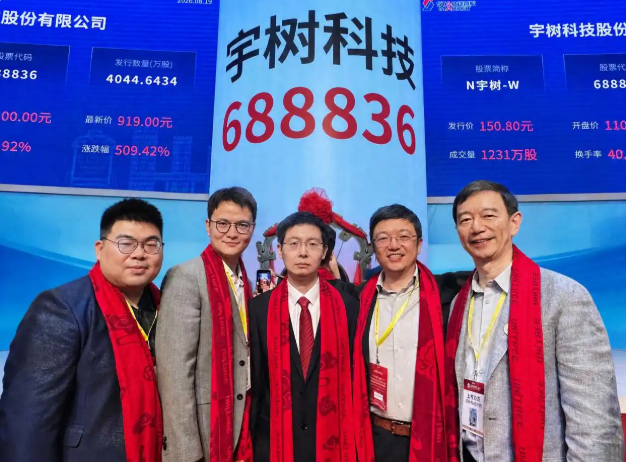
During the call auction phase, the stock price opened at 1100 yuan per share, surging 629.44% from the issue price of 150.80 yuan, with the corresponding total market capitalization reaching 444.9 billion yuan at one point. Investors who subscribed for one lot (500 shares) paid 75,400 yuan, and their opening profit reached 474,600 yuan - this was the most lucrative "meat lot" on the STAR Market in 2026.
However, the excitement did not last long. About ten minutes after the opening, the stock price fell back to around 895 yuan, with the market capitalization stabilizing at around 360 billion yuan, and the intraday fluctuation nearing 20%. A key background is that the tradable shares available for trading on the first day of Yushu accounted for only 7.44% of the total share capital, with the remaining 92.56% locked up. This means that the market capitalization of the order of magnitude of 400 billion yuan is not the consensus pricing of most investors, but rather the result of a very small number of chips being pushed up under extreme scarcity.
The data at the issuance level also set a new record: the number of effective online subscription investors reached 9.7846 million, the highest ever for the STAR Market; the winning lot rate after call back was only 0.0181%, a new low for the STAR Market. The strategic placement lineup included social security funds, DeepSeek, Tencent, China National Petroleum Corporation, etc., accounting for 20% of the issuance quantity.
From the acceptance of the IPO application on March 20th to its listing on August 19th, Yushu completed the entire process in just 152 days, with only 73 days from acceptance to the meeting, which can be described as "passing the meeting at the speed of light". The sponsor institution is CITIC Securities.
Ten years: From a 200 yuan hand massage prototype to a billionaire founder
The story of Yushu began with a prototype.
In 2015, the quadruped robot "XDog" designed by founder Wang Xingxing during his school years won an award at the Shanghai Robot Design Competition. After a brief job in Xinjiang, he chose to start his own business. When Yushu was established in 2016, its registered capital was only 100000 yuan; In November of the same year, angel investor Yin Fangming acquired 15% equity through a cash capital increase of 2 million yuan, corresponding to a post investment valuation of approximately 13.33 million yuan.
In the following decade, Yushu took a clear path of "exchanging price for quantity":
-In 2017, Laikago, the first commercial quadruped robot based on XDog reconstruction, was delivered;
-In 2020, A1 pushed prices into the consumer level range for the first time;
-In 2021, Go1 entered the mass market with a retail price of 16000 yuan and appeared on the CCTV Spring Festival Gala that same year;
-In 2023, Go2 broke through 10000 yuan for the first time at a price of 9997 yuan, and the global market share of quadruped robots has exceeded 60% for several consecutive years.
2023 will be a crucial turning point. Yushu directly transferred the motion control algorithms and self-developed core components accumulated in the quadrupedal era to humanoid robots. In August, the first full-size humanoid H1 was launched - only 5 units were sold that year, with an average price of 593400 yuan, which is a typical scarce commodity pricing.
The medium-sized humanoid G1 will be released in 2024, and the product matrix will rapidly expand in 2025. In July, R1 entered the consumer level with a starting price of 39900 yuan and was named the best invention of 2025 by Time magazine; H2 will be released in October with a full-size high-end 31 degree of freedom card slot. So far, the four models cover a complete price range of 39900 to 499800 yuan.
In the Spring Festival Gala of the Year of the Snake in 2025, 16 H1 performances of "YangBOT" completed national level exposure, and the proportion of domestic revenue jumped from 44.26% in 2024 to 56.35%.
On the day of its listing, Wang Xingxing held a total of approximately 121 million shares, with a stock market value of 133.573 billion yuan based on the opening price, officially entering a net worth of billions. He directly holds 23.82% of the shares and controls 68.78% of the voting rights through a special voting arrangement of "one share, ten votes" (still 65.31% after issuance), with highly concentrated decision-making power.
The largest book profit among external shareholders is Meituan: Meituan holds a total of 9.65% of the shares before the issuance, with a cumulative investment of about 420 million yuan. After going public, it was diluted to 8.68%, with a book floating profit of about 38 billion yuan calculated at the opening price, and a capital return of about 92 times.
The profit truth behind explosive growth
In 2025, the revenue will increase by more than 10 times in three years, jumping from the fourth place in the industry to the second place, second only to Ubiquitous (with a revenue of about 2 billion yuan in 2025). But the three-year compound annual growth rate of 226.8% far exceeds that of the industry.
The business structure has undergone a historic reversal. In 2025, the revenue of humanoid robots will reach 868 million yuan, a year-on-year increase of 711.2%, accounting for 51.78%, surpassing quadruped robots for the first time (698 million yuan, year-on-year+202.2%) to become the largest source of revenue. Humanoid robots shipped over 5500 units throughout the year, ranking first in the world with a market share of approximately 32.4%; 23037 quadruped robots were shipped, a year-on-year increase of 222.8%. As of the time of listing, a total of about 18000 units have been produced offline.
The quality of profitability depends on the caliber of deduction. The difference between the net profit attributable to the parent company of 278 million yuan and the net profit after deducting non recurring expenses of 591 million yuan in 2025 is more than double. The main body of the difference is a share based payment of 349 million yuan, which is fully included in management expenses but does not flow out in cash. After exclusion, the non recurring net profit margin for 2025 reached 34.77% - while the non recurring net profit margin for the same period was -35.71% for Uber, -25.05% for Yuejiang, and -30.07% for Leju Intelligent. In a generally loss making track, Yushu is one of the few companies that truly runs through the profit loop.
But the turning point has already emerged in the first quarter of 2026. Q1 revenue was 423 million yuan, with a year-on-year growth rate significantly dropping from 332.3% to 68.49%; The net profit attributable to shareholders after deducting non recurring expenses was 40 million yuan, a year-on-year decrease of 52.55%, and the net profit margin after deducting non recurring expenses shrank from 33.80% in the same period last year to 9.52%. The money was mainly spent in two areas: an additional 38.33 million yuan in research and development expenses compared to the same period last year, and a sales expense of 140 million yuan (+133.3% year-on-year) driven by the 2026 Spring Festival Gala. The company expects a revenue of 1.052 billion to 1.13 billion yuan in the first half of 2026 (actually disclosed as 1.152 billion yuan).
Moat: Cost is the top priority for humanoid robots
The robotics industry has an open secret: the hardware solutions for humanoid robots are converging. Rotating joints, dexterous hands, LiDAR, and other BOM lists are becoming increasingly similar, and motion control algorithms are open sourced by both parties. There is no technological gap in the technical roadmap.
But the cost gap is widening. Yushu's gross profit margin for 2025 is 60.4%, which is about 20 percentage points higher than the industry average, and the gap is widening year by year - in 2023, its gross profit margin will only be 44.8%, which is at the industry level.
The cost advantage comes from three accounts:
The first step is route selection. Yushu has been betting on the "motor-driven+planetary reducer" rotary joint solution since the XDog era, bypassing the two cost mountains of hydraulic systems and planetary roller screws. The lead screw is one of the most expensive components on Tesla Optimus' cost reduction journey and has long relied on imports. Yushu's integrated joint encapsulates the motor, reducer, driver, and sensor into the same housing, while the planetary reducer develops its own tooth profile for leg foot impact conditions. The number of parts and the cost of a single joint are simultaneously reduced.
Second step: self-developed and self-produced core components. In the industry, the cost of purchasing high-precision motors, reducers, and sensors is high, and Yushu has turned this threshold into its own profit. The self-developed rate of core components exceeds 95%, and the cost of self-developed joint motors is only half of the imported version. In 2025, mechanical components accounted for 50.8% of the 794 million yuan raw material procurement, with customized procurement of non core components such as machined parts and die cast parts being the main focus, and all core components being self manufactured.
Thirdly, reuse and scale. Humanoid and quadruped share joint drive, mechanical structure, battery management, and software algorithms. In 2025, the proportion of direct materials in the main operating costs will increase to 81.73%, and direct labor will be diluted from 13.97% in 2023 to 8.08%. The annual capital expenditure is only 50 million yuan.
The results of the three accounts can be verified by reverse calculation: the unit cost of humanoid robots has decreased from about 80000 yuan in 2024 to about 61300 yuan in 2025, a decrease of 23.46% in one year. However, the gross profit margin of humanoid robots has decreased from 87.67% in 2023 to 63.18% in 2025, indicating that Yushu is actively exchanging cost advantages for price and share - quadruped robots have proven that this strategy is feasible: a price reduction of 6.27%, a cost reduction of 16.03%, and a gross profit margin increase from 43.71% to 56.72%.
Valuation: 219 times PE, buying an unrealized 'brain'
Yushu's issuance price is 150.80 yuan, corresponding to a post issuance market value of 60.993 billion yuan, with an issuance P/E ratio of 219.23 times - while its "General Equipment Manufacturing Industry" has an average static P/E ratio of only 38.56 times in the past month, with the former being 5.7 times that of the latter. The market to sales ratio is about 36 times, far exceeding the level of Hong Kong stock peers' must choose and Vietnam Xinjiang's less than 20 times.
The valuation has gone through three levels of jumps: the final round of market-oriented financing in June 2025 resulted in a valuation of 12.7 billion yuan, followed by a corresponding issuance price of 61 billion yuan, and then surged to the level of 400 billion yuan on the first day of trading. The valuation increased by 4.8 times in 14 months, and the opening price on the first day was 35 times higher than the valuation of the previous round of financing.
What is bought at a high premium? The answer is' brain '.
Yushu himself admitted in the risk section of the prospectus: "In the early stage, R&D investment focused on ontology structure and motion control, namely ontology and cerebellum. Starting from 2024, we gradually strengthened our R&D investment in embodied large models, namely the brain. During the reporting period, we have not yet carried out large-scale real data collection and factory deployment training
One account in the expense table leaked a shift in advance: cloud computing power leasing and cloud service fees, with a total of 1.2278 million yuan in 2024 and 15.1543 million yuan in 2025, increasing by 12.3 times in one year.
The original plan for this IPO was to raise 4.202 billion yuan, but the actual fundraising was 6.099 billion yuan, exceeding the fundraising by nearly 2 billion yuan. The direction of fundraising is highly directional:
Research and development of intelligent robot models: 2.022 billion yuan, accounting for 48.13%
Ontology research and development+new product development: R&D projects account for 85.15% of the total
Manufacturing Base: Only 624 million yuan
In the budget of the model development project, the majority of the R&D implementation cost of 899 million yuan is for computing power leasing, and the equipment purchase of 402 million yuan is for the training and inference platform of the large model. The essence of IPO fundraising is the 'brain'.
And the market trend has shifted from ontology to the brain. According to IT Orange statistics, among the top 20 robot companies in terms of financing scale in the first half of 2026, 9 are ontology companies but most have the full stack capability of "data+brain+ontology", while 7 are purely embodied brain companies - about three-quarters of the targets are directly related to the brain and data. Yushu is still a pursuer in this dimension.
Three obstacles: questions to be answered for a market value of 400 billion yuan
No matter how astonishing the stock price is on the first day, it is only the result of the combined effect of liquidity and emotion. To sustain a valuation of 400 billion yuan in the long run, Yushu still has three hurdles that cannot be avoided.
Firstly, liquidity and pricing fragility. On the first day, only 7.44% of the shares were tradable, and the market price was determined by a very small number of chips. As a comparison, Zhipu and MiniMax had approximately 4% -5% of their initial public offering shares, while Changxin Technology had approximately 6.73%. These companies have undergone significant valuation repricing after going public. The fluctuation of nearly 20% from 1100 yuan to 882 yuan on the first day of Yushu has demonstrated the fragility of this pricing. With the lifting of restrictions on the sale of shares and the expansion of circulation, the true market pricing will come. Yushu investors have publicly stated that the expected reasonable market value is not more than 300 billion yuan, and it will only have reference value after the proportion of circulating shares exceeds 15%.
Second question: Where are the real application scenarios. In response to the inquiry letter from the Shanghai Stock Exchange, Yushu disclosed that from January to September 2025, research and education accounted for 73.60% of the revenue from humanoid robots, commercial consumption accounted for 17.39%, and industry applications accounted for only 9.01%. However, the industry applications were mainly focused on enterprise guidance, and the revenue truly used for clear industrial scenarios such as intelligent manufacturing and intelligent inspection accounted for only 29.29% of the industry application portion. The main sources of income are university laboratories and exhibition halls, not factories.
This is not a problem for the Yushu family. According to data from Analysys, the total global sales of embodied intelligent robots in 2025 will be over 14000 units, of which nearly 5000 units will be used for entertainment, cultural and tourism performances, over 3000 units will be used for education and research, and less than 2000 units will be truly implemented in industrial production. Performance earns enough volume, research earns start-up funds, but neither can provide sustained economies of scale from 1 to 100. If the application scenario cannot be quickly taken over, the slope of the growth curve will become increasingly difficult to maintain.
The third question: When will the 'brain' catch up. Yushu will open source the universal WMA model and VLA model in September 2025 and January 2026, respectively. The industrial grade model UnifoLM-X1-0 will not be piloted in its own factory until early 2026, and can independently complete joint motor assembly. A robot that can dance and a robot that can work in the factory are separated by what this fundraising aims to supplement. The efficiency of spending money will become the first variable in valuation - and in history, Yushu was a company with light assets to almost "stingy". The total cash paid for the purchase and construction of long-term assets from 2023 to 2025 was less than 66 million yuan, and now it holds nearly 6 billion yuan in fundraising. Whether it can be efficiently transformed into a technological barrier is still unknown.
Industry milestones, not pricing endpoints
The listing of Yushu Technology is a milestone for China's humanoid robot industry - it marks a new stage of capitalization and commercialization in this field, from concept verification in the primary market. As one of the few companies in the industry that has achieved profitability, the world's largest shipment volume, and a leading cost advantage gap, Yushu deserves the attention of the capital market.
But every premium in the 400 billion market value is a prepaid tuition fee for Yushu's "brain" and "application scenarios" by the market. Technology has never been a straight line from the laboratory to the factory and then to thousands of households: the Ford Model T was produced in 1908, and the complete production line was not completed until 1913; Intel produced its first microprocessor in 1971, which delayed the start of the information revolution by several years.
At present, Yushu has a cost advantage and is aware of its own disadvantages. Listing is not the end, but the starting point for a new round of investment. After the overall flow expands and emotions recede, the market will eventually use quarterly reports to reprice this company - and the real test is just beginning.